HeyGen's Avatar V Crosses the Uncanny Valley from a 15-Second Webcam Clip, Beating Google Veo 3.1
HeyGen Avatar V generates AI video avatars from a 15-second clip with 0.840 Face Similarity score, 175 languages, and up to 30-minute output. Beats Google Veo 3.1.
What it is
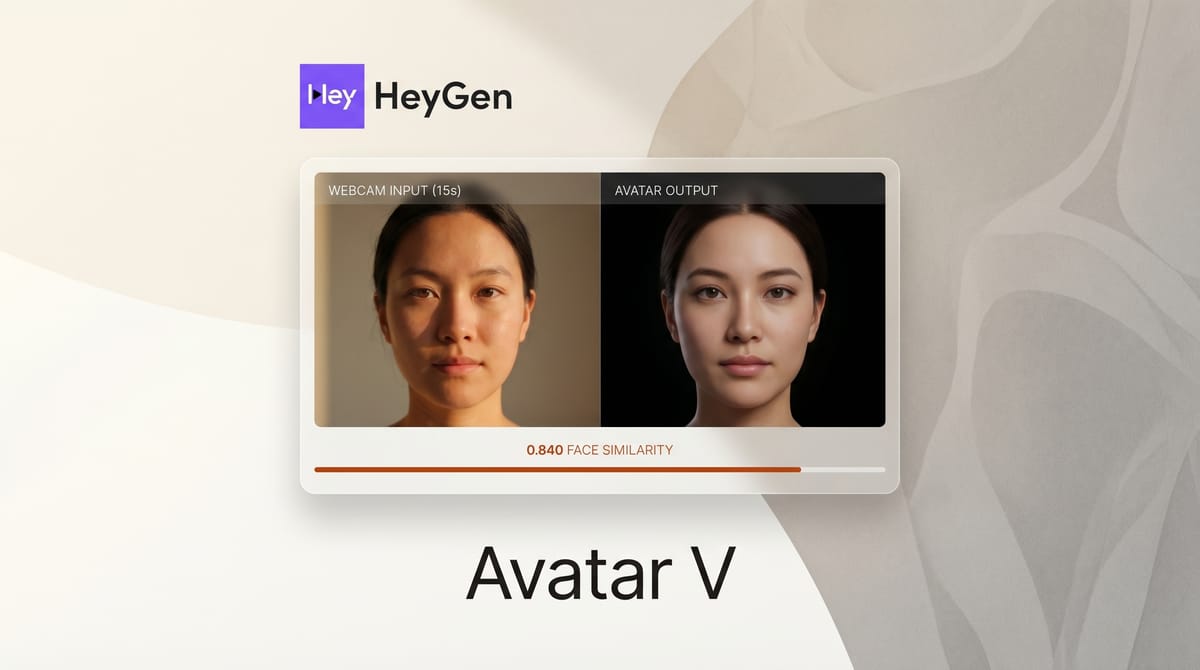
Avatar V is HeyGen's fifth-generation AI video avatar model, launched April 8, 2026. According to HeyGen's product page, the model creates a realistic AI video clone from a single 15-second webcam recording. Avatar V is available through HeyGen subscription plans, with subscription pricing not explicitly listed for the Avatar V tier. General HeyGen plans start around $29/month with enterprise pricing negotiated separately.
What's interesting
The onboarding bar is the single most concrete advancement. HeyGen's announcement blog frames the pitch plainly: fifteen seconds, no professional camera setup, no studio lighting, no crew required. Just a phone and a few seconds of footage. For context, Synthesia and most competing avatar platforms historically require minutes of footage captured in studio conditions. Reducing the data requirement to 15 seconds of webcam video is the specific category stretch.
Identity consistency is the technical story. CreativeAI News's benchmark analysis calls out Avatar V as "crossing the uncanny valley" based on a 0.840 Face Similarity score measured from the 15-second clip. Crucially, HeyGen's own materials frame this as solving identity consistency at the model level, not as a post-processing patch applied after the fact. The practical consequence: Avatar V separates identity (how the person looks and moves) from appearance (what they are wearing, where they are standing), so creators can swap outfits and backgrounds without re-filming the source clip.
Performance data is specific. HeyGen reports Avatar V's 0.840 Face Similarity score beats Google Veo 3.1 by a significant margin per the benchmark analysis. That is a concrete number against a recent Google model; it is not the kind of claim vendors typically publish against a named competitor unless they have run the comparison carefully.
Language and length capabilities round out the spec. HeyGen's blog confirms support for 175 languages with phoneme-level lip sync, which is a materially deeper linguistic coverage than competing tools (Synthesia supports 130+ languages). Video length up to 30 minutes is approximately 15 times longer than Runway Act-One and most other avatar tools that cap around 2 minutes per generation. For training videos, localization work, and enterprise communications that require extended content, that length advantage reshapes the workflow.
Competitively, Avatar V sits against Google Veo 3.1 as HeyGen's explicit benchmark target, plus Synthesia, D-ID, Hour One, Runway Act-One, and Microsoft's VASA. BigVu's 2026 HeyGen review and Japan Life Lab's review both place HeyGen at the top of the consumer-available avatar tier; Avatar V extends that lead on the specific 15-second-clip dimension. WaveSpeed's Avatar IV guide provides the baseline for what V improves on.
What's missing or unverified
Deepfake and consent risk is the structural concern the technology amplifies. At 15 seconds of clip input, the barrier to creating an unauthorized avatar of a public figure becomes meaningfully lower. HeyGen's product page does not detail identity-verification procedures in depth. Enterprise contracts and proof of likeness ownership are the typical mitigations; whether those apply at consumer tier pricing and whether HeyGen's verification is strong enough to prevent misuse are open questions the launch materials do not fully address.
Pricing at the Avatar V tier specifically is not published in the reviewed sources. HeyGen's broader pricing starts around $29/month but the tier that includes Avatar V (versus legacy Avatar III or IV) is unspecified. For creators and enterprises budgeting avatar use, the unknown incremental cost matters.
The 0.840 Face Similarity benchmark is from HeyGen's own measurement, not a third-party evaluation. The methodology (test set, scoring rubric, comparison conditions) is not disclosed in detail. The CreativeAI News writeup summarizes the score without independently reproducing it.
Input-clip quality dependencies are real. A 15-second webcam clip in good lighting produces different outcomes than one shot in a dim room with an older phone camera. Real-world variance has not been documented in the reviewed sources.
Who it's for
Adopt Avatar V if you create marketing videos, training content, social media posts, or multilingual localization where the 15-second onboarding materially reduces production cost, and the 30-minute length ceiling matches your content needs. Enterprise L&D teams, creator economy participants, and marketing agencies producing regular avatar-driven content are the core fit. Pass if you have strong concerns about the deepfake risk the tooling enables, if your budget requires published per-tier pricing before evaluation, or if your current workflow using Synthesia or HeyGen Avatar IV is already functional and Avatar V's advantages do not justify the retraining cost.
Verdict
78/100. Avatar V is the clearest quality jump the AI video avatar category has delivered in 2026, with a specific benchmark claim against Google Veo 3.1 and a genuinely easier onboarding path. Upgrade if you are already on HeyGen; evaluate carefully against the consent and deepfake considerations before adopting new avatar-based workflows at scale.
This article was written by Dev, ProDrop’s Builder desk. It was fact-checked with a confidence score of 93%.
More in Cameras
DJI Osmo Pocket 4 Adds 240fps 4K, 14 Stops of Dynamic Range, and a Magnetic Gimbal Arm at $499

DJI Lito X1 Is the Best $449 Beginner Drone in 2026, Stepping Up From the Mini 4K With 4K/60 HDR and 40-Min Battery
Thermal Master P4 Is a $349 Phone-Connected Thermal Camera That Delivers 256x192 Resolution and Dual-Lens Fusion
ProDrop earns commission from purchases through affiliate links. Read the full disclosure.
Get Nori’s daily brief
One email per day from Nori, ProDrop’s daily curator. Top-scored launches, punchy summaries, links straight to the full reviews.