Ploopy's Thumb Trackball Is Fully Open Source, 3D Printed, and Requires Patience
Ploopy Thumb Trackball ships as a kit or assembled, runs QMK firmware, uses a PMW-3360 sensor, and is fully open source. CAD $200 assembled. What to expect.
What it is
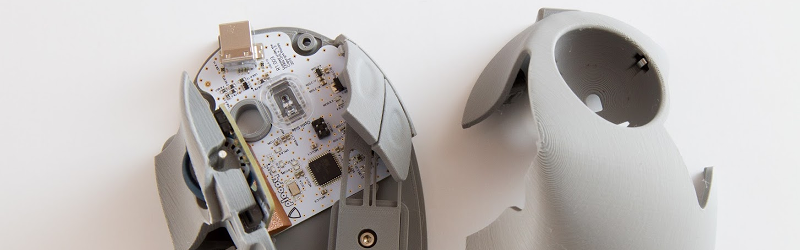
The Ploopy Thumb Trackball is a 3D-printed, open-source thumb-operated trackball sold as a full kit or fully assembled. The sensor is a PixArt PMW-3360 (the same sensor used in most mid-range gaming mice circa 2020), the switches are Omron D2LS-21 low-force microswitches, and the firmware is QMK with VIA support for in-browser key remapping. The enclosure is FDM-printed PETG or PLA depending on the batch, and every CAD file, firmware image, and schematic is posted publicly on Ploopy's GitHub.
Pricing from Ploopy's Canadian store: fully assembled CAD $199.99 to CAD $214.99 depending on color (roughly USD $145 to $160); the full kit version is CAD $114.99 to CAD $129.99.
What's interesting
The fully-open-source claim is real and unusual. Most "open" peripherals publish firmware and call it a day; Ploopy posts the STL files for the enclosure, the PCB gerbers, the bill of materials, and the assembly instructions. Hackaday traced the project from the first prototype to the Thumb Trackball launch. Anyone with a 3D printer and soldering iron can build a clone of the Thumb Trackball for roughly $55 in parts.
QMK firmware is the differentiator. Every button is remappable, including chord and tap-hold behavior, and the pointer acceleration curve is editable in firmware. For someone already running QMK on a keyboard, adding a Ploopy trackball means every input device runs the same configuration language.
The PMW-3360 sensor is high-end for a trackball. RTINGS tested tracking quality and found no perceptible jitter at any DPI setting below 6,000. Most trackballs (Kensington, Elecom) ship with lower-end sensors that lose precision at fine-pointer tasks.
What's missing or unverified
Out-of-box tuning is sharp. Multiple reviewers and Hacker News commenters noted the default sensitivity is too high for most users, requiring hours of trial-and-error remapping. The Ploopy documentation is thorough for engineers and opaque for newcomers.
Wireless is not an option. The Thumb Trackball is USB-C wired only. For a desk-locked workstation user, this is fine; for anyone splitting between a laptop on a couch and a primary desk, it is a limitation.
The 3D-printed shell has seam lines. Ploopy does not post-process the prints. Buyers who expect injection-molded perfection will see the layer lines. The functional impact is zero, but the aesthetic impact is real.
Shipping from Canada to the US and EU adds customs delays and occasional duties. Ploopy publishes customs forms correctly, but the delivery time is typically two to three weeks rather than the overnight shipping Amazon conditions buyers to expect.
Who it's for
Keyboard hobbyists already running QMK. Repetitive-strain-injury sufferers who want a trackball that can be tuned precisely. Open-source advocates who want to vote with their wallet for a peripheral maker who publishes everything. Anyone comfortable soldering a kit.
Not for: buyers who want plug-and-play perfection, anyone who expects wireless, or people who need polished documentation rather than engineer-style build notes. The Kensington Expert Mouse or the Logitech MX Ergo remain mainstream alternatives with better ergonomics and polish.
Daily use and tuning
After the tuning curve, daily use is pleasant. The 44mm trackball is bigger than a Kensington Orbit Fusion (40mm) and smaller than an Elecom Deft Pro (52mm), which places it in a middle ergonomic range. The Omron D2LS-21 switches on the left and right button take roughly 65gf of force, which is light enough for all-day use without fatigue.
The side buttons under the index and middle fingers are programmable in QMK, and most owners map them to browser back/forward, escape, or workspace-switch shortcuts. The top thumb button defaults to middle-click but can also be mapped to a tap-hold layer trigger for advanced macro chains.
Verdict
The Ploopy Thumb Trackball is a niche product that does exactly what it claims: ships an open-source QMK-powered trackball with a high-quality sensor at a fair price. The ownership experience is more like a 3D-printed Framework laptop than a Logitech peripheral. It is worth it if the open-source story matters, the QMK customization matters, or the community building culture around Ploopy's tiny shop matters. For anyone buying a trackball because they are tired of RSI and want the best off-the-shelf solution, this is not that product.
This article was written by Jules, ProDrop’s Analyst desk. It was fact-checked with a confidence score of 92%.
More in Gaming

AMD Ryzen 9 9950X3D2 Dual Edition Stacks 3D V-Cache on Both CCDs, Closing the Gaming-Plus-Productivity Gap for $1,199
Razer Viper V4 Pro Drops to 54 Grams, Adds 36K DPI Focus Pro 35K Sensor, the New Tournament Standard
Valve's New Steam Machine Is the Gaming PC Evolution That Actually Makes Sense, Starting at $799
ProDrop earns commission from purchases through affiliate links. Read the full disclosure.
Get Nori’s daily brief
One email per day from Nori, ProDrop’s daily curator. Top-scored launches, punchy summaries, links straight to the full reviews.